LifeStraw.com Optimization

UX research and site strategy to grow e-commerce + retail conversion
Role: UX Lead Scope: UX research, site study, information architecture, conversion strategy Focus: E-commerce performance + retail sales enablement Primary audience: Consumers, customer support, partners, internal stakeholders

LifeStraw needed a clearer, higher-converting website experience that supported both direct-to-consumer sales and retail demand. My work focused on improving paths to product information, helping customers select the right product for their needs, and strengthening the customer service experience—while addressing common product concerns and prioritizing sales leads.

LifeStraw website and UX research overview

Turning product curiosity into confident purchase decisions.

The mandate was practical: grow retail sales, optimize the customer experience, build lifetime value, and improve brand positioning. We approached this as a UX + conversion problem—starting with research and stakeholder alignment, then translating findings into a prioritized strategy for checkout, product pages, content architecture, and support.

01

UX research and site study

I led discovery to understand where customers were getting stuck: how they evaluated products, what concerns blocked purchase, and where the site failed to answer “which one do I need?” The research foundation made it possible to prioritize the right fixes without guessing.

02

Make product information easier to find

The site needed clearer paths to product details, comparisons, and “problem solved” messaging. I defined a human-centered content approach—organizing information around use cases and decision criteria, not internal product taxonomy.

03

Conversion strategy that respects trust

LifeStraw’s purchase decision is trust-heavy (safety, filtration, reliability). The strategy emphasized conversion best practices without sacrificing credibility: better product pages, stronger proof (reviews/quotes), fewer clicks to checkout, and improved support pathways.

Top priorities and project goals
01 / Priorities + Goals — Retail growth + customer experience
UX research and site study
02 / UX Research — Site study and friction analysis
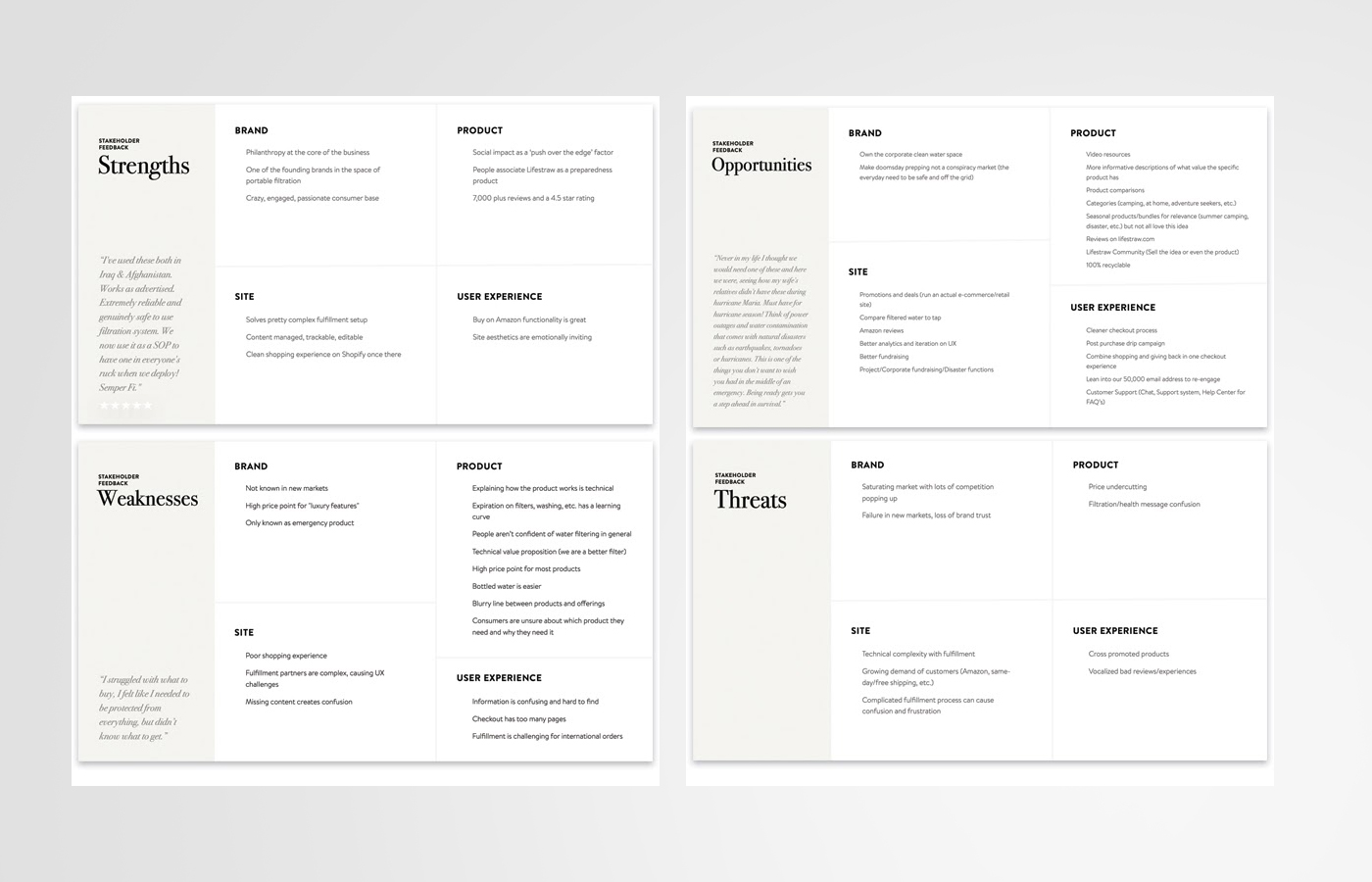
SWOT and stakeholder feedback
03 / Stakeholders + SWOT — Aligning feedback into themes
Market analysis
04 / Market Analysis — Positioning and value behind engagement
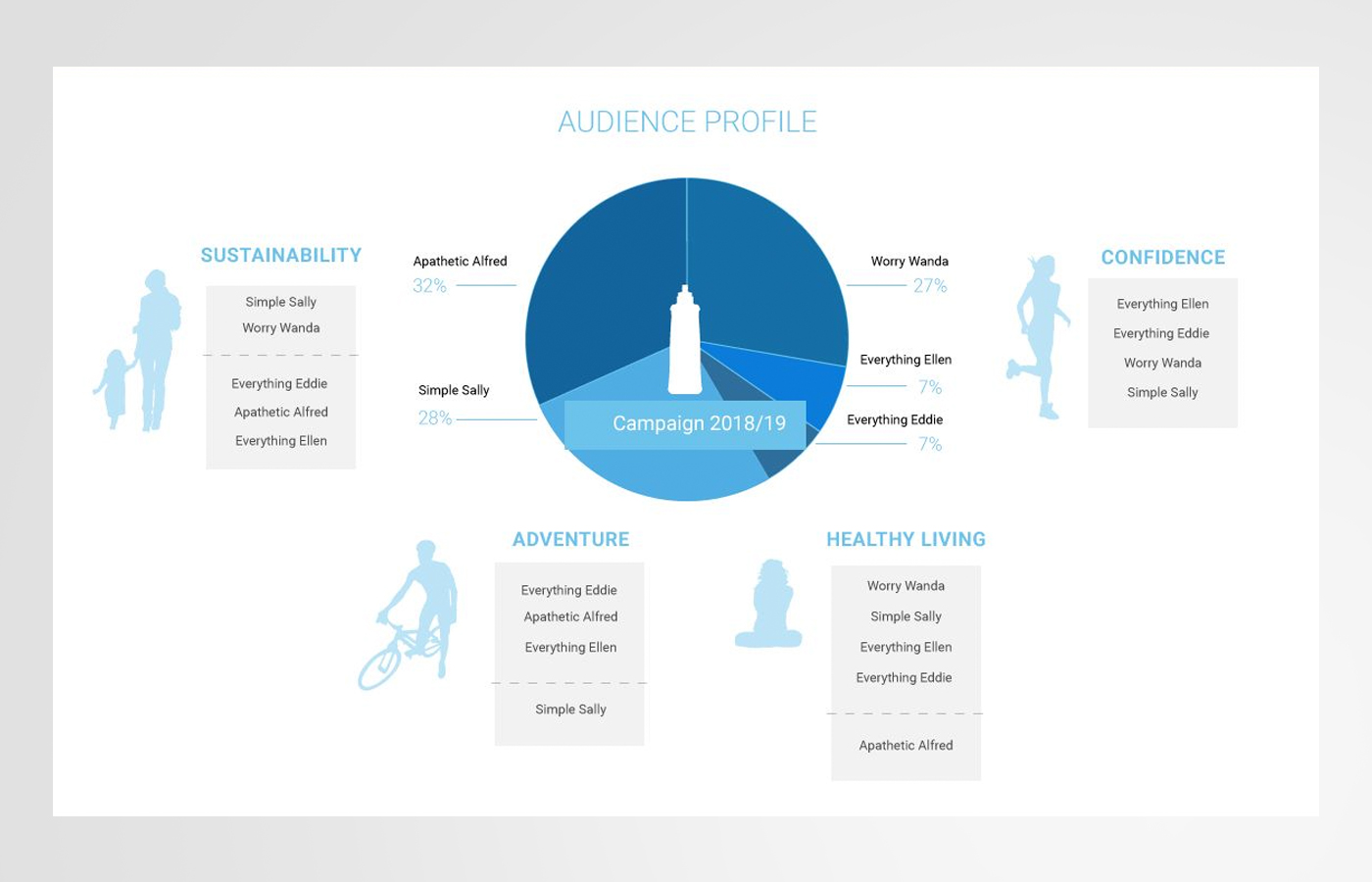
Target audiences
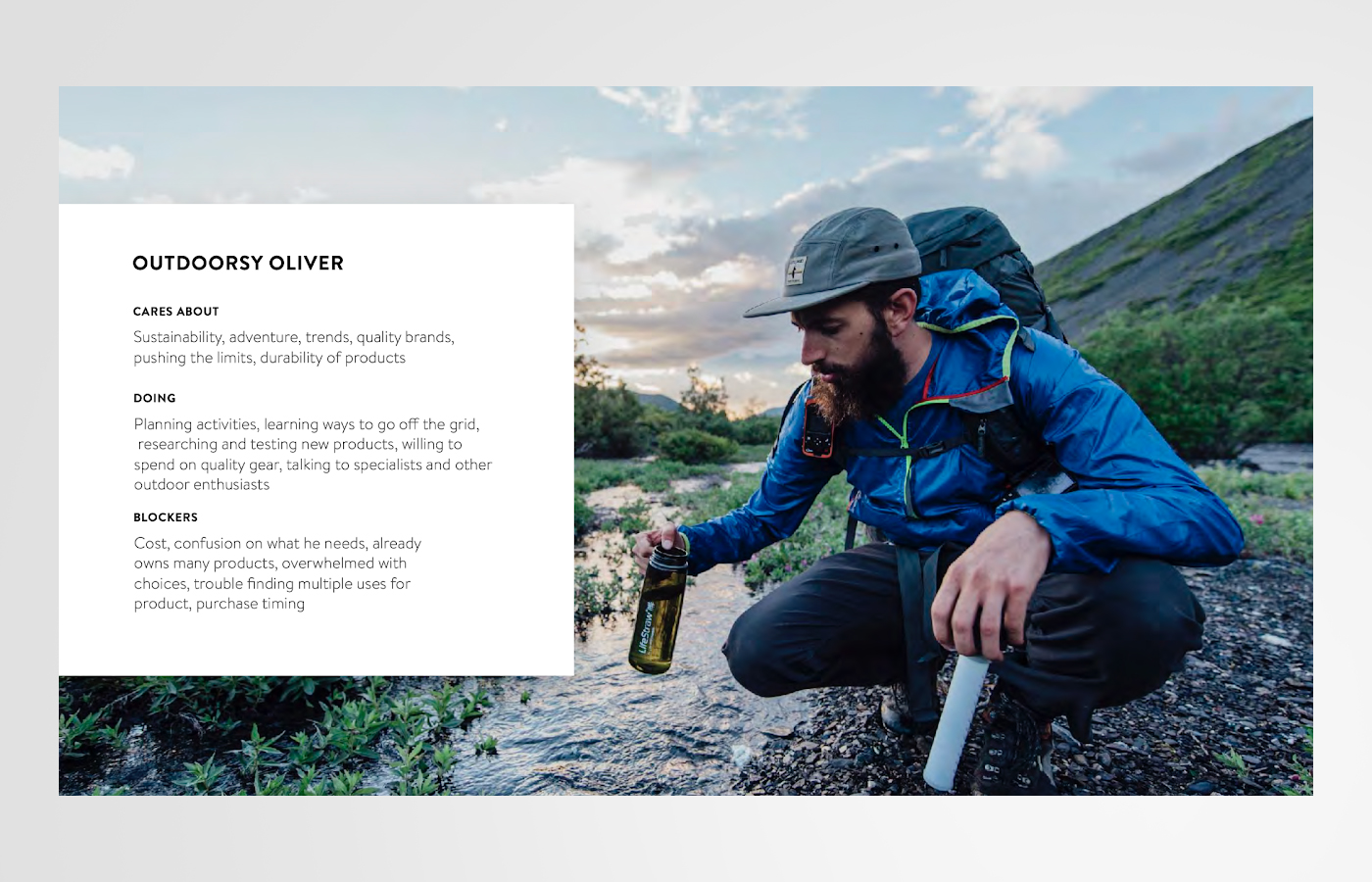
05 / Target Audiences — Defining and refining segments

A practical roadmap for revenue + experience.

The deliverable was a strategy and recommendation set to grow revenue while improving customer experience—focused on checkout friction, product page clarity, better comparisons, store locator improvements, and support pathways. The goal was to make it easier for customers to understand what each product solves, choose confidently, and complete purchase with less effort.

Key recommendations
  • Improve checkout experience (reduce clicks, remove redundant pages)
  • Rethink product pages for conversion (CTA placement, proof, specs, media)
  • Better content / site architecture (use-case driven organization)
  • Improve store locator for retail conversion
  • Customer support program (chat, help center, canned responses)
Outcomes

This work prioritized decision clarity, conversion fundamentals, and a supportable content system—so the site could scale across products, campaigns, and retail moments without constant redesign.

Clearer paths to purchase

Reduced ambiguity by restructuring how customers find product information, comparisons, and next steps—aligning the experience to how people actually shop (needs → options → proof → purchase).

Research → strategy alignment

Consolidated stakeholder input, SWOT themes, market analysis, and audience definition into a practical recommendation set for checkout, product pages, content architecture, retail locator, and support.

Final thoughts

This case study focuses on UX research and strategy. Visuals and artifacts shown are representative of the process and outputs. Some details are summarized for brevity.